Conference Season begins

Every (other) year, I try to make a pilgrimage to one of ‘my’ conferences: International Congress on Medieval Studies at Kalamazoo, International Medieval Congress at Leeds, smaller regional medieval conferences… This year, I’m the ambitious idiot who is hitting up both, presenting at both, and wondering if I have a few screws loose.

Medieval conferences are fantastic fun for me. I get to be an academic geek for four days and have great conversations with my people. My pedagogy and research methodologies are challenged and grow in ways I hadn’t thought of. And, of course, there’s the fun swag, the book room, and the epic mead tasting every other year at K-zoo. And the time I bought that early Anglo-Saxon bucket book that I will never top, because who doesn’t need a book that specific?

I actually showed my students the excursion list for Leeds, and was gratified to see sparks of interest light up several pairs of eyes. Leeds is a first for me, so it’ll be interesting to see the difference between K-zoo and Leeds. Plus, castles. ALL THE CASTLES! (Wait, there are panels at Leeds?)

So while I try to use conferences as a teaching tool, a networking opportunity, and a research trip, I’m also looking forward to reliving my undergrad glory days in the Valley dorms and just having some quiet time. Because the end of the year is always a hectic whirlwind, and I’m so going to be ready for a vacation when I get home.

King Artus, Palomides, and finding Color in the Round Table

We’re halfway through the semester, and we’ve reached the Malory portion of King Arthur. We’ve covered chronicle, romance, and now we’re working our way through The Other. Funnily enough, the Other is a little absent in the Arthurian canon. We have Sir Morien, Palomides and his brothers (Safir and Segwarides).  Next week, we read King Artus, the only extant Hebrew Arthurian romance, which reconfigures Arthurian romance tradition to be more accessible for a Hebrew audience.

We’ve established that learning, education, science, and medicine as we know it basically moved from the civilized Middle East and Asia into the barbaric west. We’ve situated Britain as the ass-end of the Roman Empire and the flyover zone of the early Middle Ages in Europe. We’re working our way through the idea that a potentially backwater Celtic/Welsh/Romano-Briton warlord could become the exemplar and basis for the fantasy of knights in shining armor. And I still feel like I’m struggling as a font of knowledge to try and educate students on the ‘reality’ of the Middle Ages.

We always begin with a caveat: there is no universal experience for women/people of color/lower classes/minorities in the Middle Ages of Western Europe. Then I post resources on the board: MedievalPOC on Twitter and Tumblr, the story of Buddha that was translated and adapted into Old Norse, and any websites I’ve come across lately that help push and prove the idea of a Global Middle Ages. I’m going to troll the list of Medieval YA novels to find the especially diverse ones (several promising ones under “The Crusades” and “Medieval Europe, the Continent, and Byzantium”). What else can I do?

I don’t know. Prepare for a better answer when a student asks me, “Wait, weren’t all the knights white?” Do a better job of trying to educate myself, my students, and the world at large. Or, when all else fails, sing lots of “True Colors” at the top of my lungs and take Cyndi Lauper’s words to heart as I try to reclaim, in my own way, medieval history and literature for diverse voices.

And if that fails, I’ll go back to Tumblr and read more “I lik the bred” variations.

Resources I’m currently reading;

BLACK AND LIMINAL IN CAMELOT by Kris Swank, Pima Community College, Tucson, Arizona

Race, Racism, and the Middle Ages: Tearing down the “whites only” medieval world

Hiraeth

From Y Geiriadur Mawr, “longing, nostalgia, grief.” Literally, in Welsh, hir (long)

img_5432
Lake Mackenzie from the Lake Mackenzie Hut, Routeburn Track, Fiordland, January 2008

and aeth (grief). Hiraethu, its verb form means “to yearn, to sorrow.” There are mugs and shirts that proclaim that hiraeth is “not homesickness. Homesickness is too weak. You feel hiraeth. A longing of the soul to come home.”

A decade ago, I became a temporary kiwi, and I was lucky enough to live in the Land of the Long White Cloud for a year. I explored the  North and South (and Stewart) Island from top to bottom, as much as I could, while trying to find myself and my ultimate destiny (as an office monkey and occasional ESL teacher). I haven’t been to every Lord of the Rings filming location, but I think I came pretty close.

While I was there, I’ll admit I cried more than I probably should have. Then I felt some pretty powerful hiraeth: I wanted to come home. Then I arrived back in the US, back to the town where I’d lived since I was born, and discovered I felt hiraeth for an entirely different place: New Zealand.

Thanks to the powers of Facebook and the interwebz, I’m happy to now have a name for this longing. Part of me wonders if Cymru settled in my soul a little more than I thought, in the six weeks I was there in the summer of 2012, because some of the uniquely Welsh words speak to me. English seems like such a limited language sometimes, and I love that I can reach out to other languages to find a word that expresses exactly what I feel. Like when it’s 30 the day after we have a glorious day of 65 and sunshine, and all I feel is kawawa. Thank you, Tagalog, for perfectly summing up the amount of pathos and pity I feel for myself.

I’m celebrating eight years in New York State, land of snow and clouds and farms and apples and glorious falls (followed by six months of winter). I’ve traveled east and west and south to other hemispheres, I make the cross-country flight back to California at least three times a year, and yet, I still find myself feeling hiraeth. Is it a lack of home, which is the life of the itinerant academic? Or is there just something about the history and culture of New Zealand that keeps calling me back? Like Moana and the ocean, “it calls me.”

Someday I will find the time to pursue my Victorian chivalry/Maori treatment by the military in WWI research project. Someday, I will fuse my interest of community-shaping story with the culture that I love. And until then, I’ll keep looking at twelve years of pictures of five visits to New Zealand and fueling my hiraeth.

22 students walk into the library…

This week is Library Week, where I’m actually dragging King Arthur students into Special Collections to view a sampling of ten books. My goal: a crash course in the history of the book, medieval paleography and codicology. The result: students in absolute awe that someone handwrote (“like, really, by hand?”) what they held in their hands seven centuries before.

“But it’s so neat!”

Which led to a discussion of scriptoriums and the poor monk at the bottom of the totem pole whose only job is to do lettering, much like in modern comic books. Which turned into a quick discussion on the profession of the writer and how they could move up in the world. Which will hopefully lead into an ongoing conversation about the power of books in our lives, and how precious these living artifacts are.

I’m sorry that I haven’t taken advantage of the library resources before this. Every time I teach a medieval lit class, wherever that might be, I’m going to do my best to take my students into the archives and to present them with the physicality of history. Because there’s nothing like smelling parchment and feeling paper and seeing the difference between early print and late script, and knowing that SOMEONE in the distant past made this book, all for you.

Aue, aue
We are explorers reading every sign
We tell the stories of our elders
In a never-ending chain

-“We Know the Way,” Moana

“How did King Arthur die?”

Once upon a time, a medievalist decided it would be a good idea to have a child in the little girl on war horsemiddle of dissertating. This child arrived along with Hurricane Sandy in October 2012, earning her the nickname Stormageddon Stormborn, Dark Lord of All — the Stormborn for short. While she wasn’t present at the actual defense itself, she played a huge role in completion of the dissertation and in this Mama PhD’s role as an academic. So the medievalist decided to use her expertise as a doctor of medieval literature — not that kind of doctor — and educate the Stormborn’s preK class about King Arthur, knights, parchment, and the Middle Ages in general.
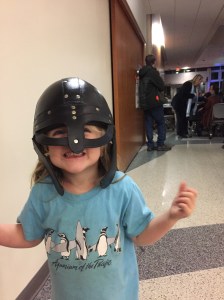
This wasn’t my first time as a medievalist in an elementary school classroom. And believe me when I say that it’s harder to keep 4 and 5 year olds’ attention, rather than second and third graders. Especially when said 4 year olds climb in your lap while you’re showing pictures of illuminated manuscripts. But was it worth it? A thousand-fold. They wore my leather viking helm, they pretended to blow my drinking horn as if they were in the midst of battle, they put the chainmail on their heads and fingered the parchment and quill pens without me telling them to. Passing around physical artifacts engaged them tacitly while I showed them pictures for my old illustrated copy of Pyle’s Knights of the Round Table and from my old paleography/codicology textbook. The biggest problem was the objects not getting passed all the way around the circle; I actually discovered one of my leather vambraces discarded in the corner when the teacher noticed two kids playing duel with my wooden sword and drinking horn.

small girl wearing viking helm
The smallest knight at Medieval Night

While the Stormborn was not in the mood to perform (she who randomly runs around the house in bits of armor, or asks to play with ink and parchment), I was happy to expose the other 13 kids to an era they might not learn about again for years and years to come. There are fantastic lesson plans on the Middle Ages available for elementary and high school, and Fitchburg State University is hosting a second Annual Medieval Studies Workshop for Middle and Secondary Educators. I’ve seen panels at multiple medieval conferences, including the International Congress at Kalamazoo. Resources exist. Medievalists who would love to set foot into the K12 classroom exist. Access to artifacts even exist, if we reach out to our local SCA/Renaissance Faire/LARP club. Not everyone has an attic full of costume armor, or has made parchment, but it’s easy enough to find inflatable swords and pound scraps of parchment.

The hardest part was when one of the kids asked “How did King Arthur die?” Well, it kind of involved his son/nephew and a battle, but you don’t need to know about what incest is just yet. Or the politics behind spending too much time conquering and not enough time managing domestic affairs. I don’t want the Stormborn or her classmates to be medievalists, but I do want them to know that the stories exist for a reason. That there was a time when the stories were fact and fiction. And that the reason why we still love to hear about knights is because they had a huge impact on Western European culture in the Middle Ages. Chivalry isn’t dead, and while I doubt 4 and 5 year olds will understand its social and historical nuances, it can’t hurt to engage them in the physicality of history now. It’s not about accuracy and context yet. It’s about helping these kids realize that history is a real, living thing, and that it affects all of us. And it’s my job as a medievalist (and my duty as a mama) to bring these stories — pulling that sword out of the book — to life.