Once upon a time, a medievalist decided it would be a good idea to have a child in the  middle of dissertating. This child arrived along with Hurricane Sandy in October 2012, earning her the nickname Stormageddon Stormborn, Dark Lord of All — the Stormborn for short. While she wasn’t present at the actual defense itself, she played a huge role in completion of the dissertation and in this Mama PhD’s role as an academic. So the medievalist decided to use her expertise as a doctor of medieval literature — not that kind of doctor — and educate the Stormborn’s preK class about King Arthur, knights, parchment, and the Middle Ages in general.
This wasn’t my first time as a medievalist in an elementary school classroom. And believe me when I say that it’s harder to keep 4 and 5 year olds’ attention, rather than second and third graders. Especially when said 4 year olds climb in your lap while you’re showing pictures of illuminated manuscripts. But was it worth it? A thousand-fold. They wore my leather viking helm, they pretended to blow my drinking horn as if they were in the midst of battle, they put the chainmail on their heads and fingered the parchment and quill pens without me telling them to. Passing around physical artifacts engaged them tacitly while I showed them pictures for my old illustrated copy of Pyle’s Knights of the Round Table and from my old paleography/codicology textbook. The biggest problem was the objects not getting passed all the way around the circle; I actually discovered one of my leather vambraces discarded in the corner when the teacher noticed two kids playing duel with my wooden sword and drinking horn.
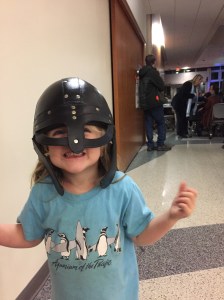
While the Stormborn was not in the mood to perform (she who randomly runs around the house in bits of armor, or asks to play with ink and parchment), I was happy to expose the other 13 kids to an era they might not learn about again for years and years to come. There are fantastic lesson plans on the Middle Ages available for elementary and high school, and Fitchburg State University is hosting a second Annual Medieval Studies Workshop for Middle and Secondary Educators. I’ve seen panels at multiple medieval conferences, including the International Congress at Kalamazoo. Resources exist. Medievalists who would love to set foot into the K12 classroom exist. Access to artifacts even exist, if we reach out to our local SCA/Renaissance Faire/LARP club. Not everyone has an attic full of costume armor, or has made parchment, but it’s easy enough to find inflatable swords and pound scraps of parchment.
The hardest part was when one of the kids asked “How did King Arthur die?” Well, it kind of involved his son/nephew and a battle, but you don’t need to know about what incest is just yet. Or the politics behind spending too much time conquering and not enough time managing domestic affairs. I don’t want the Stormborn or her classmates to be medievalists, but I do want them to know that the stories exist for a reason. That there was a time when the stories were fact and fiction. And that the reason why we still love to hear about knights is because they had a huge impact on Western European culture in the Middle Ages. Chivalry isn’t dead, and while I doubt 4 and 5 year olds will understand its social and historical nuances, it can’t hurt to engage them in the physicality of history now. It’s not about accuracy and context yet. It’s about helping these kids realize that history is a real, living thing, and that it affects all of us. And it’s my job as a medievalist (and my duty as a mama) to bring these stories — pulling that sword out of the book — to life.
 The Sword in the Book